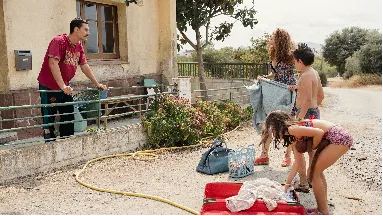
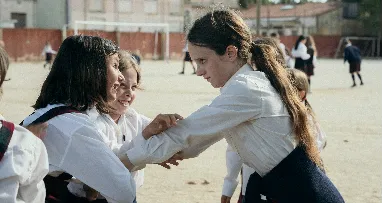
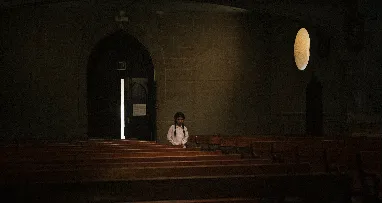
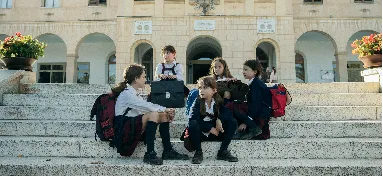
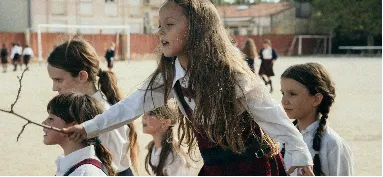
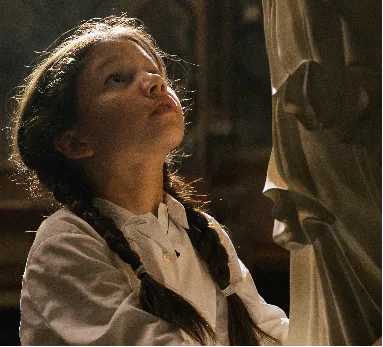
In ´La Mesías», it all starts with a musical video of a Pop Christian band made up by several sisters that has gone viral and that has a strong impact on Enric, a man tormented by his childhood, marked by religious fanaticism and the oppression of a mother with messianic ravings. «La Mesías» is a family thriller that tackles overcoming trauma, faith as a tool to fill a void, education, childhood, trauma, the possibility of forgiveness, and art as the only means to escape terror. It is a 7 episode by 50 minutes dramatic series that narrates the two protagonists´ voyage towards healing, and that mixes past and present with multiple points of view.
Our story comes to be due to our obsession with portraying faith in its different perspectives, and we were particularly interested by those families who, caught between ravings and fanaticism, locked their sons and daughters in their homes to carry out a divine mission commended only to them. There are emblematic cases such as the Angulo brothers in the United Stated who grew up without ever leaving their apartment in Manhattan, completely isolated from society. They only had access to some movies on DVD, «The Dark Knight», «Pulp Fiction», «Reservoir Dogs», and a small video camera. Deprived of all freedom, they spent their days, months and years recreating those films in the living room. Or the Wiggin sisters, whose father locked them in the basement because an entity told him that they had to form a music band and revolutionize the world. The Wiggin sisters formed The Shaggs and, with no outside references, the created their music from zero. They played around with their instruments until they created a sound and songs that were both ridiculous and flawless. They were even internationally famous for a time.
After exploring these realities and finding many common thread between them, we have built the story of our family.
Years after the opening of “Holy Camp!”, our first stage play and movie, in which we portrayed faith as something full of light, we realized that it also had a darker, perturbing side that we had not explored. To that end, after lengthy research to different forms of religious fanaticism, we discovered the stories of families who, after a divine call, decided to lock their sons and daughters in their houses to carry out the mission that a deity had entrusted them with.
We started investigating these families and we found stories of all kinds all over the world: siblings who, for years, had never been outside the four walls of their house and knew nothing else. Some of them only had access to three or four movies and a small camera with which to recreate their favorite scenes, others only had a few musical instruments with which to compose their own songs without any outside musical reference… However, there was a common thread in all these stories: art, music, films, this is what saved these people from complete isolation. From terror. It offered them a means of escape. It gave them hope. It allowed them to dream, if only for a while, that they were somewhere else. Living a different life.
Once we were able to identify the common factors in all these stories and we had immersed ourselves in the reality of the testimonies of what they had experienced, we built a world and a family that are fiction, yes, but have great realism as we have drawn from the cases we investigated.
With “La Mesías”, we not only wish to take a leap forward as regards the subject matter of the series, but also as regards the aesthetics of our creations. Moving forward in darkness, elegance and maturity. Which is why we have taken note of Paul Thomas Anderson’s films “Magnolia” and “The Master”. Both stories have a lot to do with faith, lost characters on the verge of a breakdown, characters marked by anxiety, trauma and pain. The scene where it rains frogs in “Magnolia” or the character of Freddie Quell (Joaquin Phoenix) in “The Master” and his relationship with Lancaster Dodd (Philip Seymour Hoffman).
To create this story, the protagonists, their psyche and their point of view are key.
Starting with Montserrat, the mother who is the beginning and the end of everything, a narcissistic mother who grows darker and darker, and who reminds us of “Mommy”, by Xavier Dolan. Memories full of light from when she was young and voluble, the almost oedipal relationship with Enric rings true with the mother and son in this film. A mother who rears her children in an environment marked by abandonment, an absent mother, driven to madness by a nullified husband, as in “Nobody Knows”, a masterpiece by Koreeda, also inspired by real events.
Among Montserrat’s children, we first focus on Irene and Enric, the main protagonists, and her children from her first marriage. The siblings’ relationship in the past has a lot to do with “Incendies” (Dennis Villeneuve), and also in their actions, unravelling the secrets in their mother’s past. Discovering terror and tragedy, and the link it creates between them, is also very present in our story. As is the deep pain of “Manchester by the Sea”. In the present, Irene and Enric have lost the close relationship they shared as children, and Irene does her best to live an integrated life in the ordinary world. But there is a deep sadness within her, her gaze masks a profound pain with which she struggles on a daily basis and that reminds us of the protagonist of “Personal Shopper” by Olivier Assayas.
When we enter the world of Stella Maris, made up Montserrat’s daughters from her second marriage, Enric and Irene’s stepsisters, we drink from films such as “Little Women”, “The Virgin Suicides” and “Mustang”.
As to its subject matter, “La Mesías” could remind us of the existentialism, desperation, mystery and religious imaginary of “The Leftovers”. We want to make the spectator ask questions, keep the audience hooked to the story. We will also use multiple points of view, something that greatly enriched “The Leftovers”. We must not forget that, oftentimes, an obsessive religious belief conceals a void and trauma, and we will enter the world of paranormal beliefs, as in alien abductions associated with childhood abuse, drinking from “Mysterious Skin” by Gregg Araki. If all these religious aspects are associated with Pop with hints of magical realism, we could be talking about series such as “The Young Pope” by Sorrentino.